Codesphere Reactives
This is a detailed guide for Codesphere Reactives. For an overview of all runtime types and how to choose between them, see Runtimes Overview.
Codesphere Reactives are a runtime environment that lets you define your application environment using standard bash commands exactly as you would on a local machine or VM while the platform handles all infrastructure management automatically. You get the freedom of imperative Linux configuration without building, managing, or thinking about containers. The runtime combines the power of traditional server environments with automatic scaling and minimal infrastructure overhead when not running.
Overview
Unlike traditional serverless platforms that are stateless and limited to short-lived function executions, or traditional VMs that consume resources continuously, Codesphere Reactives combine benefits from both paradigms:
| Feature | Traditional Serverless | Traditional VMs | Codesphere Reactives |
|---|---|---|---|
| Environment Configuration | No - Constrained runtimes | Yes - Full OS management required | Yes - Standard bash commands |
| State Persistence | No - Stateless | Yes - Full state | Yes - Shared filesystem |
| Resource Efficiency | Yes - Pay per use | No - Always running | Yes - Off-when-unused |
| Startup Time | Seconds | Minutes | Seconds |
| Long-running Processes | No - Time limits | Yes - Unlimited | Yes - Unlimited |
| Environment Control | No - Limited | Yes - Full control | Yes - Flexible via Nix |
| Infrastructure Management | Yes - Automatic | No - Manual setup & maintenance | Yes - Automatic |
Architecture
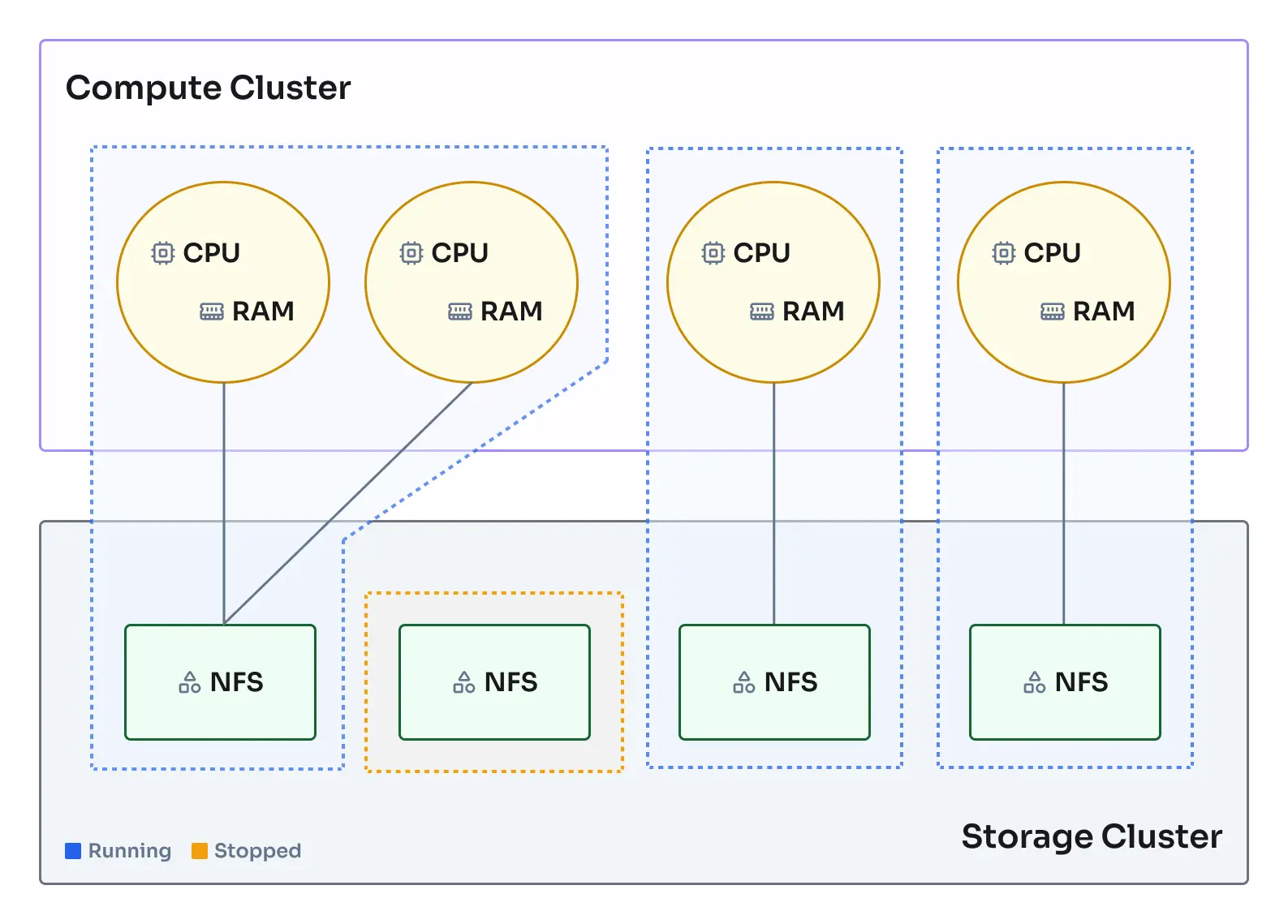
Codesphere Reactives are fully functional Ubuntu open standard containers orchestrated using our patented deployment orchestration for improved startup performance. For private cloud deployments, the base image can be freely customized by organization administrators. Our architecture enables the rapid startup times that make Reactives the technology powering all Codesphere Workspace cockpit deployments. Each instance receives a network filesystem volume that persists across restarts and replicas, allowing you to write to the filesystem as you would on a local machine. When idle, Reactives automatically scale to zero, releasing compute resources while preserving the filesystem state. On the next request, they restart from a pre-warmed pool.
Key Components
Shared Network Filesystem
Each Reactive has access to a high-performance network filesystem that provides persistent storage across restarts and replicas. You can mount any file or directory from the network filesystem to any destination in your container. By default, files in /home/user/app are preserved, while other locations use ephemeral storage.
Resource Management
Pooled compute instances across multiple nodes enable instant startup and automatic resource deallocation during idle periods. Unused resources are immediately available to other workloads, and wakeup logic restarts services on-demand.
Kubernetes-Based Orchestration
Built on Kubernetes with health monitoring, load balancing, auto-scaling, and graceful shutdowns - all managed by the platform without requiring any Kubernetes knowledge.
When to Use Codesphere Reactives
Development Use Cases
Reactives excel during development because you can run code scalably without needing to rebuild container images constantly. This makes iteration fast and efficient:
- Rapid prototyping and testing
- Quick dependency changes without Docker/Container Image rebuilds
- Instant code changes with hot reload
- Scalable development environments that mirror production
Production Use Cases
Reactives are used in production by customers scaling to 70+ replicas and large enterprises who value the ease of use and minimal DevOps overhead:
- Web services and APIs with automatic scaling
- Microservices architectures
- Stateful applications with persistent storage needs
- Low to high traffic services with efficient resource utilization
- Cost-sensitive workloads that benefit from off-when-unused behavior
Migration from VMs
Reactives work well for applications migrating from traditional VMs, particularly when:
- The application can run without root access
- Local dependencies (installed via Nix or package managers) are sufficient
- You want to modernize without extensive refactoring
Production Considerations
When using Reactives in production, ensure reproducibility by:
- Pinning dependency versions explicitly in your prepare steps
- Documenting all application setup steps in the
ci.yml - Testing the full prepare and run cycle to ensure consistency
- Using Nix for deterministic dependency installation
When to Consider Managed Containers Instead
Use Managed Containers when:
- You need a specific base OS or distribution
- You have existing OCI images
- You want dependencies pre-baked for guaranteed reproducibility
- You require specific system-level packages not available via Nix
Configuration & Lifecycle
Codesphere Reactives are configured through the ci.yml file in your repository. For comprehensive guides on configuring and managing Reactives, see:
- Configuring a Landscape - Complete guide to landscape configuration
- Configuring CI Pipeline - Detailed pipeline setup including prepare and run stages
- Landscape Lifecycle - Understanding deployment, scaling, and lifecycle management
- Environment Variables - Managing environment configuration
- Secret Management - Secure handling of sensitive data
- CI Profiles - Managing different configurations for dev, staging, and production